Showing posts with label Read~Reflect~Respond. Show all posts

Friday, January 13, 2012

Books I'm Reading in 2012 -- A Small Start Anyway!

Dear friends,

Many of my friends and fellow bloggers have posted their 2012 intended reading lists.  Last year I posted a 2011 reading list but didn't read them all.  Maybe someday I should compile a list of the books I actually did read (all or in part) last year, but I've completely lost track of them.

I can't predict all of the books I'll read this year, since many of them come to me unexpected and I just enjoy them as they come. Nevertheless, here is the start of my reading list, though some of these books I am already reading and just need to finish them.

You can click on the book titles to see (or order) them at Christian Book Distributors or Amazon.

Inspiration:

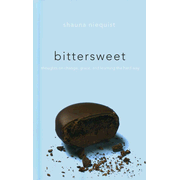
Bittersweet: Thoughts on Change, Grace, and Learning the Hard Way 
by Shauna Niequist

Bittersweet: Thoughts on Change, Grace, and Learning the Hard Way  -     
        By: Shauna Niequist
    
My friend (and favorite author) Gary Thomas has recommended Niequists's book Cold Tangerines on FB many times, so I asked my husband to get it for me for Christmas. I loved the book and so did my daughter Joanna.  Right now, my daughter Julia is reading it.   I already mentioned it in this post on one of my other blogs: Friday Favorites: Recalibrating for the New Year. I found the sequel, Bittersweet, at my favorite used bookstore, Brightlight.  Any book with a picture of chocolate on it has to be good. It's got short essays about the Christian life based in stories from her own life.  I seriously don't know how people can write like that.  I am insanely jealous.  She is a bit more liberal than I am, I think, but still quite worth the read.

The Divine Conspiracy: Rediscovering Our Hidden Life in God
by Dallas Willard

The Divine Conspiracy   -     
        By: Dallas Willard
    
Gary, who specializes in Christian contemplative classics, also told me to read something by Dallas Willard to recover some of my lost joy. The Divine Conspiracy looks like a good one, and I think I can get it from the public library.  It's a thick one, though, so I may have to renew it once or twice!  Hopefully, it will renew me, too.


Orthodoxy (free on Kindle)
by G.K. Chesterton 


Orthodoxy   -     
        By: G.K. Chesterton
    
Chesterton was a contemporary and friend of C.S. Lewis.  "Witty" and "profound" are the two words that come to mind when I think of the writing style of Orthodoxy.  You have to think about this book, which is a Christian classic.  I particularly appreciate his kind words about those of us who think more poetically than logistically.  Chesterton reminds us to break out of our airtight little circles of rigidly "rational" thinking and stretch our brains and our hearts to a larger life. I like that.

Breath for the Bones - Art, Imagination and Spirit: Reflections on Creativity and Faith  
by Luci Shaw

Breath for the Bones: Art, Imagination and Spirit: A Reflection on Creativity and Faith  -     
        By: Luci Shaw
    
Another one on my "halfway through but need to finish up" list!  I've already blogged about it in these posts: Is My Head in the Clouds? and Ivory and Gray.  If I get really brave, I might take a breath and dip my bones into the book Studying Poetry by Stephen Matterson and Darryl Jones, both of Trinity College Dublin.  I don't know where I got it, but I think someone passed it along to me recently.


by Timothy Keller

Generous Justice: Finding Grace in God Through Practicing Justice  -     
        By: Timothy Keller
I already blogged about this one here: Just Beauty and Even More Weekend Gratitude.  It shouldn't take me long to finish!


Parenting & Education:

Going Public: Your Child Can Thrive in Public School
by David & Kelli Pritchard

Going Public: Your Child Can Thrive in Public School  -     
        By: David Pritchard, Kelli Pritchard, Dean Merrill
    
I've been home schooling my 10 kids for 20 years, but now I have two in public school: a junior who started in her sophomore year and more recently my third grader who started just before Thanksgiving.  Both are doing very well, and I'm confident we made the right decision. This book is a field guide for Christian parents who want their kids to thrive in public schools.  


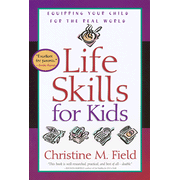
Life Skills for Kids by Christine Field


Life Skills for Kids                                          -     
        By: Christine M. Field
This is one I need to plow into -- one of my weak areas as a mom and a home manager!  I bought it used at a home school curriculum sale last spring. I. Will. Read. This. Book. (Eventually.)


Grace Based Parenting
by Dr. Tim Kimmel

Grace-Based Parenting  -     
        By: Tim Kimmel
    
I've actually been writing a series of reflections about this book on www.ComeWearyMoms.blogspot.com, so I won't write more about it here.  Needless to say, I've already finished a good chunk of it!


Fiction: 

The Help
by Kathryn Stockett 

My daughter Joanna took me to see the movie at the dollar theater a few weeks ago, and I enjoyed it so much that my daughter Mary gave the book to me. I have a strong interest in social justice, and the Civil Rights era is one that I have always covered in our home schooling.  I've read plenty of kids books on the topic, but this is the first grown-up one.  (Yes, I admit, I've never read To Kill a Mockingbird.  Maybe I should add that to my list, too.)  The book is written from the points of view of three women -two black maids and one white journalist - living in Jackson, Missisippi in 1963, which, by the way, is the year I was born.

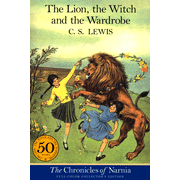
The Lion, The Witch and the Wardrobe
by C.S. Lewis

The Lion, the Witch, and the Wardrobe, The Chronicles of Narnia  Commemorative Edition  -     
        By: C.S. Lewis
    
I'm reading this one with my kids.  It's been a while, and I don't think the younger ones have ever heard it even though they have watched the movie.  There are so many other books I want to read to my kids this year, but I can't even get started on that list right now!  I haven't been doing as many books with them lately since we are in the home school co-op, but for next year I am thinking of doing another "read through our shelves" year with world lit.  It's been tough getting motivated with home schooling this year. Am I up for that?  I'm actually thinking I could get some of my zest back that way.  Hmmm.  I guess that will be a matter for prayer and research!

So I know that's not everything I'll read this year, but I suppose it's a representative sample!

What are you reading?  Share it in the comments!

Virginia Knowles
www.VirginiaKnowles.blogspot.com

Tuesday, November 22, 2011

The End, The Beginning, and the In Between

"The end of the matter is better than the beginning, and patience is better than pride.  Do not be quickly provoked in your spirit, for anger resides in the lap of fools... Consider what God has done.  Who can straighten what he has made crooked?  When times are bad, consider: God has made one as well as the other. Therefore, a man cannot discover anything about his future."  Ecclesiastes 7:8, 13-14
                                                      
I jotted this passage in my journal on August 31, along with a personal reflection:

"It is easy to be proud when you are plotting out your plans for accomplishing great things - but it is going to take a lot of patience to work through the inevitable setbacks and frustrations to get there.  And the fruit of your labor is better than the mere dream of it.  Things may not go as you plan, though.  It could be that the Lord's ultimate goal is different than your dream.  He wants character in you that is humble (recognizing his control, not ours) and enduring (able to withstand the tests) and kind to the people you meet along the way. And the future will unfold, the story will be told, even if it seems "crooked" and meandering."

Looking back a few meandering months later, I am glad for the encouragement of my own words.  I need them right now in the middle of my life, in my crooked times. Isn't that one of the beauties of keeping a journal?  I can write courage and wisdom into my own future. The story does unfold, but it isn't always clear or pleasant as it happens.  We don't always know what will happen next, but whatever it is, we will need strength and grace. The same day I wrote that journal entry, I started reading Luci Shaw's book Breath for the Bones: Art, Imagination, and Spirit: Reflections on Creativity and Faith, which I have also mentioned in my posts Ivory and Gray and Is My Head in the Clouds?  This quote made it into my journal a few pages later:

"We try, in the moment, to make sense out of what may often seem horrifying, incongruous, paradoxical, irrelevant, and absurd, while retaining a kind of eschatological hope that God's order, peace, design, and glory will fill all the spaces in our widely scattered personal and cosmic jigsaw puzzles."


I am glad for the encouragement of her words, too. Jigsaw puzzle indeed.

Thanksgiving is in two days.  In light of that, I will say that I am grateful that God is in control, whatever happens, and that I know I am growing and enduring in ways I had not imagined before.  I am also very mindful of the kindness of family and friends.

Joy and peace to you,
Virginia Knowles

Thursday, January 6, 2011

Goals, Plans and Books for 2011 ~ Bring It On!

Dear friends,

“Trying to write down goals and plans for the year little by little, one area at a time. My life is rather complicated! Self-discipline is the key to much of it.”

That’s what I posted as my Facebook status last night, and my Canadian friend Natalie asked if I cared to elaborate. Yes, I guess I will! I was already plotting a blog post in the back of my head anyway.

I’m not much of one for making New Year’s resolutions of things I will do or else! But January is a fitting time of year for new starts and waxing at least a little bit philosophical about how life is going: where I’ve come from this past year and where I want to go in the next 365 days. Or should I say 359 days since it is already January 6th? Actually, the decisions we make on any day of the year in some way set the trajectory for all the rest of life, eternity included. My, that’s getting a little weighty for me.  This year may be an extra crucial one since I already know it is filled with continued major transitions for my whole family.

With this in mind, several areas of my life (such as it is) need the focus of goals and plans: 


  • Personal: Spiritual ~ Mental ~ Emotional
  • Family: Husband ~ Kids ~ Extended Family
  • Home Schooling
  • Homemaking & Creativity
  • Ministry: Writing ~ Speaking ~ Practical
  • Social
  • Physical: Nutrition ~ Exercise ~ Health & Dental Care
I think that about covers it for me. I can pretty much tuck any smaller concerns within those headings. For each of these areas, I set up a page in my notebook with three sections: 
  • Goals: the end result I want to accomplish
  • Plans: specifically how I am going to get there
  • Books to read: I can’t help it. I’ve got to get the reading in there somewhere, and if it can help me reach my goals, well, more power to me!
I’m not going to share all of my goals with you for two reasons. No, three! First, many of them are private! Second, I haven’t come up with all of them yet. I don’t like to rush the process. Like I said, “Little by little, one area at a time.” Third, you need to work through your own goals, not copy mine. I am me. You are you. Profound, I know. I will share a little bit, along with one of my book lists at the end, and maybe in a later post I’ll write about a few homemaking goals.

I have gone through this Goal & Plan process before, but it’s been years. I should dig through my old ones (I think they were written on yellow paper, and they are somewhere in one of my archive notebooks) and see whether I actually accomplished much of what I dreamed. Yes, I know I did. I mean, I survived all the toddler years of 10 kids, and my teenagers and adult children live pretty productive lives and still like me most of the time. If that isn’t a worthy feat, I don’t know what is!

Speaking of notebooks… Yes, I have a wonderful little iPod touch that helps me turn my life from ADD (Attention Deficit Disorder) to ADO (Attention Deficit ORDER). When I got this lovely little digital friend, I abandoned my old paper To Do lists in my notebook and transferred them to an electronic app that sorts and prioritizes and beeps at the schedule time and makes it easy to procrastinate (er… readjust the schedule) by tapping the “Put Off Till tomorrow” button. Anyway, back to notebooks. I still love mine and use it as a mega-journal-extra-brain-of-sorts. I stash all sorts of goodies in my notebook, which is a full 3-ring model with a sturdy blue canvas cover. Lots of reflections on life, personal Bible study & sermon notes, letters from loved ones, articles I find intriguing, outlines of projects, rough drafts of poems, and copies of whatever I have written for public consumption. Right now, I have a hefty section set aside for my goals and plans. Later on, I’ll type them in and e-mail them to the iPod for instant handy access. And maybe a few well-timed beeps.  I have other notebooks, too, but I'll save that tale for another day.

Now, since you have read along so patiently, I will share a tiny bit of my spiritual plans (the only ones I've written out so far) as well as my book list for that area. I hope it will be worth your eyeball-to-brain time.

First, I have really been lagging in systematic Bible study, so I want to commit to finishing up my study of the four gospels, in which I am reading similar passages from each on the same day and comparing them. I wrote a list of the next 16 sets of verses, figuring I can complete one of them every 3 days or so. Time to read, time to reflect, time to respond. Maybe I’ll even print out some Read ~ Reflect ~ Respond Scripture note pages for this endeavor. (That brings to mind Dave Abney’s sermon at Lake Baldwin Church on the habit of meditation from last Sunday. “The life that abounds is centered on the story of redemption.” Scripture is a mirror of our souls, a window into God’s heart, a gateway to prayer, a path to obedience.) I also want to take the plunge and memorize Scripture again, since that is such an aid to meditation. (If you can remember it, you can dwell on it even when the page isn’t in front of you. It seeps into you and becomes part of you, shaping who you are and what you do.) Ann Voskamp, one of my favorite bloggers, is recommending the whole book of Colossians as a 2011 goal, and even provides links to a booklet to help us along the way. (See here: Colossians in a Year: 2 Verses a Week.) I’ll bite. I guess that’s one way we actually can borrow someone else’s goal. I memorized it over 2 decades ago and I’m still quite familiar with the general outline, wording and concepts, even though I can’t quote large chunks of it anymore.

“Since then, you have been raised with Christ, set your hearts on things above, where Christ is, seated at the right hand of God. Set your minds on things above, not on earthly things. For you died, and your life is now hidden with Christ in God.” Colossians 3:1-2
That much I can type “by heart” since my younger children and I often sing it into our souls, memorization and meditation by melody. Those words themselves capture the spirit of why I want to saturate my mind with Scripture. I just downloaded a free NIV Bible app to my iPod to make it easier to find the verses I am going to memorize. (I already have the ESV on it.)

Oh, the book list! I’m not to going to give you all of it because some of the books I’m thinking of reading I need to investigate a bit more closely before I even mention them in public. But here is enough to keep you busy for a long time, especially if you’re not a fast reader.

When Life and Beliefs Collide: How Knowing God Makes a DifferenceWhen Life and Beliefs Collide: How Knowing God Makes a Difference by Carolyn Custis James ~ a stirring call for Christian women to become able theologians. Along the way, she recounts the life of Mary (sister of Martha and Lazarus), who sat at Rabbi Jesus’ feet to learn even though she was criticized, and later had to put her knowledge to the test and into practice during challenging times. I’m glad I’m reading this book. A friend (I can’t remember who) quoted this book on Facebook and even that little sound bite resonated with me so much that I asked Thad to get it for me for Christmas. He did, and I’m about half way through it.

Know the Truth: A Handbook of Christian BeliefKnow the Truth: A Handbook of Christian Belief  by Bruce Milne ~ a book of systematic theology for normal people like me, and a means to carrying out the above call. We’ve had it for a while, but I need to dust it off, crack the spine, and let the words spill out into me. It’s so easy to make assumptions about theology based on what we hear and feel, but how well are we thinking it through? How Biblical are our beliefs anyway? How skewed have we allowed them to get, even in our churches, not to mention culture at large? Can we “Be Bereans” and search it out with our minds fully engaged? For more theology, I also might dabble in my vintage 1918 copy of A History of the Christian Church by Williston Walker. I have found that if I try to look up some curious sect or belief, I invariably have to keep paging backwards, farther backwards to set the stage on the page. It’s all a thread, often tangled, but somehow still woven into a tapestry we won’t see the beauty or even the sense of until eternity. Nearly a hundred years later, I recognize that my life story is part of it, too. Thus my desire to live well, with worthy goals and plans.) 

Your God Is Too SafeSpiritual Rhythm: Being with Jesus Every Season of Your SoulYour God is Too Safe: Rediscovering the Wonder of a God You Can’t Control and Spiritual Rhythm: Being with Jesus Every Season of Your Soul by Mark Buchanan. I already read his book The Holy Wild nearly three years ago (my review and quotes here: The Holy Wild)  Thad saw Your God is Too Safe at Brightlight, my favorite used bookstore, and snapped it up for me. Yes! I’ll get Spiritual Rhythm at CBD soon.  Ann Voskamp  recommended it in her blog post Weekends Are for Curling Up with Good Books: I confess, many books keep me a dabbler, but Mark Buchanan’s Spiritual Rhythm: Being with Jesus Every Season of Your Soul kept me right to the end, the one book I reached for each evening after the children were tucked in bed. All of his books on my shelves, Buchanan is one of my absolute favorite writers: classic writing by a current contemporary, deep and thoughtful theology, lyrical yet muscular prose that sweeps you away — transforms you."  Based on reading The Holy Wild, I would agree! 


One Thousand Gifts: A Dare to Live Fully Right Where You AreOne Thousand Gifts: A Dare to Live Fully Right Where You Are by Ann Voskamp. The print version is not due for release until later this month, but you can already get the Kindle e-book. And yes, this is the third time I have mentioned Ann in this blog post! That’s because I love her writing, which is poetic even when she is attempting prose. Always profound. Always setting my mind on things above, and then putting my hands busy to serve “here below” in light of that. See for yourself: http://www.aholyexperience.com/.  (Just like me, Ann is also a home school mom of a large family, but quite unlike me she's also a Canadian farm wife.  The farming I shall never emulate.)


Do you catch the recurring theme in these book titles? Living fully in Jesus. Not settling for dry dust or rigid resolutions, but being open to the “impossible” but ultimately wonderful things that God loves to pour out into my life. Bring on my Grand Adventure, 2011!

Joy and peace and LIFE to you this year and always,
Virginia Knowles

Wednesday, February 3, 2010

Books & Beyond Audio: "The Bible as Literature" and "Read, Reflect & Respond"

Dear friends,

I uploaded the audio of the two workshops I presented at the Books & Beyond literature conference in Orlando last month. I have also pasted in the text of the handouts, as well as an extensive set of web links for the Bible one. The workshops include some material that is not in the handouts and visa versa. For example, at the end of the first one, I spoke for a few minutes about using the Bible to launch our children into the grand adventure of life that God has prepared for them -- in faith and not in fear.

You can find all of them on my middle school blog, www.ContinueWellHomeSchool.blogspot.com, or click these specific post links:
There is also a new post on Problem Solving in Your Home School at my preschool/elementary blog, www.StartWellHomeSchool.blogspot.com.

Joy and Peace,
Virginia Knowles

Sunday, July 26, 2009

The Joys of Mentoring

Dear friends,

Yesterday, I had the immense privilege of taking part in two very special events -- one about giving mentoring, and the other a sweet reminiscence of receiving it many years ago.

From 9 AM to 2 PM, my friends Meredith Curtis, Cheryl Bastian and I presented the Finish Well workshops about high school home education. We didn't know how many people would show up, so we were so blessed when about 40 ladies arrived. We all had a lovely day learning together. I wish I could have heard Meredith's and Cheryl's workshop! Each of us treasures the opporunity to mentor other mothers. Soon, we will try to post our workshop notes, PowerPoints, and/or videos, as well other helpful web links, so check www.finishwellhomeschool.blogspot.com/ when you get a chance.


In the evening came another absolute delight for me! Our dear friends Roger and Mel Franks were in town, and about 50 of us got together for a reunion. (You can see pictures here.) I suppose I need to back up and explain here. In 1984, I started attending Northland, which at that time was a small community church meeting in the English Estates Elementary School cafeteria. Roger was one of our pastors there. I had started visiting Northland because I had heard him teach on John 1 at our InterVarsity Christian Fellowship meeting at UCF.


I met my husband Thad there a few weeks later. We used to go to a Bible study at Roger and Mel's house during our courtship and engagement, and I grew to love and respect them for their wisdom and gentleness. They loved pouring their lives into others, which is the heart of mentoring. A year later, Roger left the pastorate and moved his family of five to Maryland to join up with the Great Commission Church there. Another year later, after Thad and I were married, we followed them up there. It was such a blessing to soak up their mentoring for the next seven years of early marriage, motherhood, and home schooling before we moved back to Florida. During those years, Mel gave birth to her final four babies (some of them premature, which required extended bed rest) and we had our first four. I vividly remember several instances where Mel spoke such words of grace and clarity to me when I was discouraged or confused. She is the one who taught me the concept of the "happy mess" -- how we should not to get upset if we see the remnants of our children's creative fun, though we should remind them to clean it up when they're done.


Mel mentioned last night at our gathering that a dear lady named Marge Nelson (pictured left) had mentored her during early motherhood. I turned to thank Marge, because mentoring is really a chain of love from older to younger, and on down the line as the younger becomes older, and then more younger women come along. So if I have mentored any of you in any way, you can thank Mel and Marge. And you can pass it along!


I think it is a tribute to Roger and Mel, and to the joys of mentoring, that so many folks would come to see them 25 years after they moved away. But you know, as precious as they are, they have been just one link in our chain. So many of you have shared your lives with us as well, and we are so very grateful to God for you!

Go explore the joys of mentoring!


Blessings,
Virginia

Tuesday, March 31, 2009

Read, Reflect & Respond in Our Home & Co-op Classroom

Dear friends,


The following article is an excerpt from the March 2009 issue of my Hope Chest e-magazine. It is a follow-up to my earlier blog post, the audio/visual workshop, Read, Reflect & Respond (The Real 3R's of Literature!)


"READ, REFLECT & RESPOND”

IN OUR HOME AND CO-OP CLASSROOM

To supplement the workshop presentation linked above, I would like to share with you just a small sample of the specific ways that we implement the Read, Reflect, Respond process in our home. I’ll start with what I do with my children, and then move on to how I use it myself.


BIBLE: My friend Heather was commenting the other day how she needed to be more consistent with teaching her kids to study the Bible. I realize that I need to work on this more than we have recently. Usually, I had just been reading a short portion of Scripture before moving on to our other books. This past week, I decided to teach them how to study it, starting with the book of Colossians. We are working through several verses each day as a group. Each of my younger kids (ages 11 and down) has a small pocket New Testament that we use at Bible time so they can all be in the same version (NIV) and on the same page. I also wanted them to be able to take notes effectively, so I went to the new Deal$ store that just opened up near us and bought five composition books for $1 each. These are good because my kids can sit on the couch with them and it’s stiff enough to write on without being as bulky as a notebook. Everything stays put in one place – no stray papers! Each one of my kids works at his/her own level. Melody, who is three, scribbles and puts stickers in hers. Occasionally I’ll write a phrase for her (“Jesus is God’s son”) and ask her to repeat it, or I draw a heart or a cross. That’s enough to keep her happy, though she still wiggles a lot. Ben, our six year old kindergartner can read and write, but not spell. I write out a list of short phrases from the verses for him to copy, such as “Bear fruit in good works” or “Pray for others.” Then he reads them back to me later. He is very pleased with his work. Naomi, our eight year old, writes down the same phrases as I say them to her. (In Charlotte Mason circles, this is known as dictation, whereas what Ben does is called copy work.) Andrew (age 11) and Micah (age 9) do what Charlotte Mason called written narration. This means they write down in their own words what they have learned. As we study, the kids read aloud the verses (recitation) and we do oral narration; that is, each child has the opportunity to comment to the group what the passage means. Dictation, copy work, recitation, oral narration. and written narration are all solid foundations for the “Read, Reflect & Respond” process. You can read more about the wonderful Charlotte Mason method in Karen Andreola’s book A Charlotte Mason Companion: Personal Reflections on the Gentle Art of Learning as well as on Jeannie Fulbright’s web site.


CHILDREN’S NOVELS AND NARRATIONS: Our current pick for a novel, at home and in my 7th-8th grade co-op class, is Roll of Thunder, Hear My Cry by Mildred D. Taylor. Part of a nine novel series on racism in Mississippi, this particular book is set in the 1930’s. It’s always been a “must read” in our house. The last time I read it aloud to my kids (several years ago) they made me do 85 pages in a stretch, without even stopping for lunch. It’s not exactly a jolly book; the end of it is very sobering. But it is a vital one for introducing key issues of life and how we deal with challenges and injustice. This book is one that I assign to my class in our Providence home school co-op the years when we study American literature. I wrote my own study guide for it, supplemented with information from the web. Instead of having my 11 year old son, who is in my class, write out all of the answers, I had him do them orally. The thoughts flow more freely this way sometimes, and it takes less time than writing it all out. (He already has a lot of other written assignments, so there is no loss there.) In January, I assigned the Civil War novel Across Five Aprils by Irene Hunt. As usual, I gave them my study guide for it, but after we “finished” the four weeks I had the hunch that some of them had rushed through it and not given it proper attention. So for the next week’s assignment, I told them to read the entire book over again. Each day, they were to write a response paragraph (a written narration) on something they had read. I told them it could be in the form of a summary, a description of a person or scene, an opinion, a poem, a journal entry or letter as written by a character, or a description of how this relates to something in their own lives. I told them to make sure each paragraph was complete, clear, convincing, and creative. Their paragraphs were absolutely delightful! I know that I will use this method again at least once a year. The second reading helps them pick up details they didn’t catch the first time around, and the response paragraphs require more creativity and critical thinking skills than just answering questions.


ESSAYS AND OTHER WRITTEN RESPONSES: Last month, I knew that I would be assigning a persuasive essay as a writing project. I wanted it to be something related to the either-or logical fallacy that we were covering in class. This kind of fallacy occurs when a situation is presented as “it must be either this or that” when in reality it could be neither or both at the same time. I wondered what to use as a specific topic for the essay. God graciously provided the answer through an e-mail conversation with a distant relative about the Great Commandment (love your neighbors) and the Great Commission (preach the Gospel). I realized that many Christians at different ends of the theological spectrum tend to focus intently on one to the neglect of the other. Some think that we should just meet people’s practical needs, and avoid sharing the gospel because they don’t want to “force their beliefs down their throats.” Others think they should just devote all of their ministry resources to communicating Scriptural truths because it takes too much time and money to try to keep up with social action and community service. My conviction is that we need both the good deeds (Great Commandment) and good words (Great Commission) fully integrated with one another for maximum effectiveness. So, I compiled a list of Scriptures on both, gave them to my class, and assigned them to write an essay on why we need both. I’ve been very pleased with what they have written so far! This is an example of examining the Scriptures, and reflecting on and then responding to the issues in them. I encourage you to use this approach in some of your writing assignments. You can find the Scriptures we used on at The Great Commandment & the Great Commission. Written responses don’t just have to be about something they have read. They have also done these for President Obama’s inauguration speech, Dr. Martin Luther King, Jr.’s “I Have a Dream” speech, as well as fine art, poetry, and carols at Christmastime. I will be posting similar Easter week assignments on-line soon.


SHORT STORIES: Well over ten years ago, I started investing in the Miller story series by Mildred Martin. I may not be a Mennonite, but these books are treasures! Our copy of Missionary Stories with the Millers is completely dog-eared from heavy use. Joanna says she read it 12 times when she was younger. Last year, I had been reading bits of it to the 5th-6th grade history class which I assist in at co-op, and one of the moms asked if she could borrow it. A few weeks ago, one of my own kids asked where it was, and I remembered that I hadn’t gotten it back. My friend brought it to me the next week, and we’ve been reading a chapter or two at home since then, as well as in that history class again. My kids beg for this book! I think it has given some of them a real heart for global outreach, which may be evident when you read the family news section of this issue. The other books in the series are Wisdom and the Millers, Storytime with the Millers, Prudence and the Millers (about health and safety) and Schooltime with the Millers. We love them all! They are not at all expensive, and some of them have activity books to go along with them. (We haven’t bought these.) The place where we buy the Miller books is www.Timberdoodle.com. We have been ordering from this excellent family-run Christian home school supplier for almost two decades. I know they don’t have the same vast selection as Christian Book Distributors, but their service is stellar, their prices are discounted, and what they do have is a fantastic variety of high quality educational materials. They specialize in hands-on fun activities, Christian character building resources, great literature, and products designed for use with autistic and other special needs children.


INDEPENDENT READING: Our kids also read by themselves. Some of this is as assignments, such as Oliver Twist by Charles Dickens for Joanna’s high school co-op class, or Little House in the Big Woods for Micah’s 3rd-4th grade class. But they also read a lot just for pleasure or personal development. The Chronicles of Narnia series by C.S. Lewis and the Little House by Laura Ingalls Wilder have always been popular in our home! I try to leave ample time for my kids to just curl up on the couch and read. I’d much rather have them do this than endless worksheets!


READ, REFLECT & RESPOND FOR BUSY MOMS


Moms, you need this as much as your children do! Are you feeding your mind and your spirit so you can keep up with the many overwhelming demands of life? Are you going deep or just trying to get through the surface stuff? Take time to read, reflect, and respond -- and set the example for your kids! What books are you reading now? What do you want to read soon? Write a list! I think I’ve heard that the average American adult doesn’t even read one full length book each year, not including what they read for work or school or to their children. However, I think you would be surprised how many life-changing books you could read if you make a plan and take the time for it – even 15 minutes a day.


As part of the “Read, Reflect & Respond” process, I take notes in my journal for some of the books that I choose. I used to use a hardbound “diary” style journal, but last year I switched to a sturdy, full sized notebook, which is much more practical for me since I can insert or remove pages as needed. In the notebook, I have three sections. The first is for whatever household stuff I need to keep track of, like a “to do” list or a budget. The second section is for my chronological journal, which includes my own reflections on daily life, records of notable things that have happened, letters or e-mails, brief quotes and my own thoughts from books I am reading, prayer requests from friends, Bible study notes from quiet times or church sermons, etc. (I don’t carry the whole notebook with me to church; instead I carry a simple folder with lined paper, and then I put the pages in the notebook when I get home.) The final section is for more lengthy book notes. If I have decided to consistently take notes for a certain book, I like to keep it all together so I can more easily reread them later. Usually, my book notes consist of my favorite quotes, short synopses (summaries) of each chapter, and my own commentary and reaction to what I am reading.


I recently finished reading I Dared to Call Him Father: The Miraculous Story of a Muslim Woman's Encounter with God by Bilquis Sheikh. In 1966, a wealthy Pakistani Muslim woman started having strange dreams about Jesus. After reading the Bible and talking to missionaries, she trusted in him for her salvation and began to live a life of surrender to God and service to her people. She eventually had to flee the country because of persecution. This book is a huge blessing to me, especially because when I first picked it up to read, I was feeling so low and discouraged. Reflecting on God’s grace in Bilquis Sheikh’s life caused me to respond with fresh gratitude and resolve to persevere with my own puny trials. I didn’t take notes on this book; I was too tired and just trying to enjoy the story! My sweet second cousin Jean sent it to me. We often share Christian books with one another, and she always seems to know how to encourage me in the faith. Do you have someone like this in your life?


I am currently reading (and taking notes on) The Screwtape Letters by C.S. Lewis. My 14 year old daughter Lydia is working through this book as an English assignment using the Progeny Press study guide, the curriculum she prefers because it provides challenging questions and writing projects. (We usually buy the downloadable PDF version and print it out in fast draft mode to save ink.) Lydia is doing English independently this year, rather than with our co-op classes. Though in 8th grade, she has received permission from our home school enrollment program to get a high school credit early, since she is doing advanced work. All six of her titles this year are British literature. Since I found an extra copy of The Screwtape Letters at a yard sale, I decided to read along so we can discuss it later. Even beyond my daughter’s academics, it is a help to me spiritually as well. It’s an unusual book, a collection of (fictitious) letters written by a demon supervisor to his underling, instructing him on how to distract and discourage Christians. It takes a little extra thinking to translate from their viewpoint (such as God is “The Enemy” and Satan is “Our Father Below”) but it’s worth the effort. Even the process of reasoning it out is so valuable in stretching the brain and heart. I find that I don’t always agree with C.S. Lewis, especially the last two chapters of the otherwise brilliant Mere Christianity. However, I know that part of the reflection stage is realizing that we need to be very discerning and not just accept everything we read – but that we can still gain valuable insight even when we don’t agree with ever last bit of something. You can get a combined Mere Christianity and Screwtape Letters volume; I think this is the one Lydia has since she asked for it for Christmas over a year go.


A few years ago, I wrote two articles related to the concepts above. You can find them at Learn to Discern and Busy, Dizzy & In a Tizzy: Christian Contemplation for Moms and Other Frazzled Folks.


The one last link that I want to give you is for a free 130 page downloadable e-book by Leigh Bortin of Classical Conversations. Even if you don’t use the classical approach to education, you’re sure to gain some great insight and ideas! You can find it here: Echo in Celebration: A Call to Home-Centered Education.

Wednesday, March 25, 2009

Read, Reflect & Respond (The Real 3R's of Literature!)

Dear friends,

In January, I presented a workshop called "The Real 3R's of Literature: Read, Reflect & Respond" at the Books & Beyond Literature Live seminar. I recorded the audio of it, and later edited it (lightly) and added related pictures and captions. You can find it below, split into four parts. The total time is less than an hour. It gets a bit fuzzy in full screen mode, so you might want to leave it small. The workshop handouts that follow are not nearly as complete as the audio/video segments (and do not replace them), but they do contain the web links to many of the books and publishers that I mentioned.

This presentation of the "Read, Reflect & Respond" concepts will be featured in the upcoming issue of my home school e-magazine, The Hope Chest, but that will have even more in it than this. If you would like to subscribe now, just send any e-mail to my automated list server at hopechest-subscribe@associate.com.

Please note: Sometimes the videos take a little while to buffer, so you may have to wait a minute or so once in a while. Also, if you have a problem with one of the web links, just e-mail me and I'll correct it. There are a bazillion in this post, so I'm sure I've messed up at least one or two!


The Real 3R’s of Literature: Read, Reflect & Respond


Introduction


  1. Life has a purpose! Reading has a purpose! Down with ignorance and apathy!

  2. The discipline of reading, reflecting and responding helps us learn to think more deeply and relate to others more wisely. We are less likely to be duped and more likely to engage in real life. We will have something worthwhile to say in a conversation. We will be prepared to meet life challenges.

  3. Reflecting and responding increases long-term retention of information, beyond the test.

  4. Our response often includes practical application and action to transform our lives and culture.

  5. Reading improves comprehension, logical thinking, creativity, writing skills, grammar, spelling, etc.

  6. Reflective reading feeds the spirit and inspires our souls. Readers become leaders!

  7. The reading, reflecting and responding stages overlap and can be simultaneous.

  8. Research the Charlotte Mason method of education for more inspiration. Read The Charlotte Mason Companion by Karen Andreola and check out www.JeannieFulbright.com/CharlotteMason.html.

  9. Use the RR&R techniques for art, music, movies, nature study, sermons, and life experiences. See http://www.providencehomeschool.blogspot.com/ Advent assignment posts for examples of this. I'll be posting Easter assignments soon, so check back in a few weeks.

♥ Mom Tip ♥ You need this as much as your children do! Are you feeding your mind and your spirit so you can keep up with the many overwhelming demands of life? Are you going deep or just trying to get through the surface stuff? Take time to read, reflect, and respond -- and set the example for your kids!


A few little quotes to amuse and inspire…

“Outside of a dog, a book is a man’s best friend. Inside of a dog, it’s too dark to read.” Groucho Marx

♥ “The man who does not read good books has no advantage over the man who can’t read them.” Mark Twain

♥ “When I get a little money, I buy books; and if any is left, I buy food and clothes.” Erasmus

♥ “A book is a garden, an orchard, a storehouse, a party, a company by the way, a counselor, a multitude of counselors.” Henry Ward Beecher

♥ “The book to read is not the one which thinks for you, but the one which makes you think. No book in the world equals the Bible for that.” McCosh

I mentioned these books in the Introduction section:

One book that has been particularly influential in my daughter Julia's interest in world missions is: Ministries of Mercy: The Call of the Jericho Road by Timothy Keller.

Read

♥ Choose carefully!

Books can make a deep and lasting impression, so avoid exposure to much “twaddle” that dulls or pollutes the mind. Reading for amusement and relaxation is fine, but be careful.

♥ Create a literature-rich environment with a well-stocked home library.

  • Kinds of reading: academic, pleasure or personal interest, skills, devotional, etc.

  • Formats: books, newspapers, magazines, web sites, blogs, books on CD or DVD

  • Genres: Scripture, realistic modern fiction, historical fiction, fairy tale, sci-fi, romance, mystery, poetry, song lyrics, plays, art, biography, history, science, how to, self-improvement, essays, etc.

♥ A variety of genres enhances and balances.

When studying a historical period, read novels, biographies, key documents, and poetry. Listen to music and speeches. Watch a movie or documentary.

♥ Help your children select books or do it for them.

  • Selecting good books takes a little research and a lot of discernment.
  • Check book lists and ask for recommendations from people you trust. My friend Meredith Curtis has great lists on her web site at http://www.joyfulandsuccessfulhomeschooling.com/.
  • Click on “inside the book” at Christian Book Distributors or www.amazon.com/ to read a chapter.
  • Do a web search on the author’s name or the book’s title to see what others say about it.
  • Stock a special bookcase with parent-approved, interesting books for your kids to choose.
  • Share your favorites with your children! Introduce a book like a friend.

♥ Evaluate reading choices by pre-screening from front to back.

  • Is it wholesome, age-appropriate, and highly recommended? Newbery & Caldecott books are a good starting point, but check each title yourself to see if it is appropriate for your child.

  • Is it accurate and fair, without being too simplistic or overly biased?

  • Is it interesting, well written, and thought provoking? What is quality of the illustrations?

  • Is the author reliable? (Your children may want to read his/her other books later.

  • Is this the right book for right now? Is it worth the time it will take to read, reflect and respond?

♥ Choose a mode of reading.

You can alternate between these during a single book:

  • Parent reading aloud to child: allows instant interaction about content, models proper speech

  • Child reading aloud: same benefits as above, plus personal practice with pronunciation and inflection

  • Reading independently – in one sitting or over a period of time (check in to see if they need help) Reading independently but with periodic parental discussion or group interaction

♥ Encourage pre-reading preparation.

Before reading, encourage your child to browse quickly, ask questions and make predictions. Preview any study guide questions before you read.

♥ Give plenty of time to read, in a quiet and comfortable setting.

♥ Read with pencil and paper handy!

A quote that is not in the audio/visual presentation:

“Children well educated, who employ their minds on serious subjects, have, for the most part, but an ordinary share of curiosity; what they know gives them a sovereign contempt for many things they wish not to know. They see the emptiness and futility of the many things which the idle and the ignorant pursue with so much eagerness and passion. Children ill instructed, and not accustomed to application, have wandering imaginations. For the want of solid nourishment to the mind, their curiosity turns towards objects which are vain and dangerous. Those who have wit often become conceited, and read books which nourish their vanity; they become passionately fond of romances, comedies, and novels, which silently instill into their unguarded breasts the poison of profane love. These imaginary adventures render their minds visionary, in accustoming them to the strained sentiments of vain romantic heroes. Children filled with thoughts of their romantic heroes, become astonished when they look around in real life, and cannot discover a single person throughout the world bearing resemblance with their ideal hero. They would wish to live like those princes and princesses who are always charming, always adored, always above every care. What a disgust for them to descend from a hero and heroine, to the low detail and drudgery of taking care of a family. Children should be influenced by books that vividly portray life in all its trials and victories. Divine providence should echo throughout its pages. Characters who suffer wrongfully in a righteous manner, and display humble dispositions, will lay a secure foundation for the time when childhood may be stolen away; perhaps through the death of a loved one, sickness, or calamity. Children need informed instruction, and models of heroes and heroines of righteousness to fill their reserves for such a time. In literature as well as in history, God who doeth all things well, must be seen through the filter of His divine love and tender care for His children and as an avenger of all who harden their neck.” Francis Fenelon, 1685, in Education of a Child: The Wisdom of Fenelon, published by Lamplighter.

Mom Tip ♥ What books are you reading now? What do you want to read soon? Write a list! You might choose a variety, including books about spiritual life, marriage, parenting, home education, homemaking, cooking, crafts, social justice issues, historical fiction, etc. My favorite authors include Elisabeth Elliott, Gary Thomas, Jerry Bridges, Emilie Barnes, C.S. Lewis, and Gary Haugen. Download free Christian classics on-line at www.ccel.org/. (Note to blog readers: My "bookshelves" are in the right hand column of my blog.)

In this section I mention these books:

This article on my web site my also be helpful to you: Learning to Read. Additionally, we have used these resources for teaching our kids to read:

Reflect


“Some books are to be tasted, others to be swallowed, and some few to be chewed and digested.” Francis Bacon

Study questions should require critical thinking, not just factual recall. More advanced questions will require a synthesis (combining) of information from different parts of the book. Go beyond the questions in a text book!

Background:

  • What kind of book is this and why am I reading it right now?

  • What is the significance of the title or cover art?

  • What is the author’s life background and worldview? What did he or she want to communicate?

  • What is the author’s tone in this book (upbeat, harsh, relaxed, urgently persuasive, funny, reverent, etc.)?

  • When and where was the book written, and under what life circumstances, such as war?


Character, Setting, Plot & Style:

  • What universal themes, such as courage, pride, justice, greed, honesty, or jealousy, are woven into this book? Which one is most prevalent? What can I learn that is applicable to my own life? (I mention the book Johnny Tremain by Esther Forbes in the audio.)

  • What perspective can I gain about these themes from this time period, culture, and worldview?

  • Which character reminds me most of myself? What would I have done if I were that character?

  • Which characters are dynamic (developing & maturing) or static (unchanging)? How do main characters learn/grow from events in the story? How do their values, fears, motives, or conflicts change?

  • Are the characters believable? What flaws do the “heroes” exhibit? What virtues do the “villains” exhibit? (In simplistic stories, good and evil are more clearly demarcated for young minds. Books for more mature readers show the realistic nuances of authentic human behavior and attitudes.)

  • How would the story be different if written from a different character’s perspective or in another setting?

  • Do the characters speak in the same manner as I do? Are any special accents, idioms or dialects used?

  • What are the main events in this story? How does the plot rise, fall and twist? Do this a chapter at a time, and then for the whole book at the end.

  • How is cause-and-effect used in this story, especially in consequences for actions?

  • What symbolism is used? What does it mean? Is the symbolism effective, understandable & significant? (I mentioned this book: The Parable of the Lily)

  • What other Biblical, literary or historical references are made in this book?

  • Are there any words that I don’t fully understand and need to look up in a dictionary?

  • How does sensory detail (what I vicariously see, hear, smell, taste, and feel) put me “on the scene”?

  • Does this book use flashbacks or drop hints about what might happen in the future?
    Can I follow the clues and make predictions? Is the outcome too predictable or contrived?

  • Does the outcome give a sense of closure, or is it unsettling or confusing?

Discernment & Application:

  • How does this information fit in with what I already know (or think I know)?

  • Humility is needed! We don’t know everything about the topic just because we’ve read a book or two.

  • Is what I am reading essentially true or in agreement with Scripture? (Obviously, no other book is perfect!)

  • Does this information contain logical fallacies or propaganda? Does it represent opinions as being hard facts?

  • Does this reading challenge my assumptions or stretch my perspective? Is this good or not?

  • What should I accept or reject from it? What do I need to fully absorb or apply?

  • Is this book what I expected? Did it answer any burning questions for me?

Aids in the reflection phase:

  • References: Bible, dictionary, encyclopedia, map, timeline, history/science text, commentaries, Google

  • Published study guides (Progeny Press, Five in a Row, or Glencoe) or parent-written study questions

  • Personal conversations, interviews with experts, discussion groups, literature classes, on-line forums

  • Journal to take notes, ask questions, and make comments as you read. I like a notebook or composition book.

  • Field trip related to story: art or history museum, zoo, bird sanctuary, horse riding, ethnic restaurant


Mom Tip ♥ Are you truly thinking about what you are reading or putting your brain on auto-pilot? Does your reading motivate and inspire you? Does it make you draw in your breath or furrow your brow?


Respond

Communication Responses (Oral, Written & Artistic)

  • Talk about it! This could be as you read or after you finish. You can do this as a parent and child, as a whole family, or as a discussion group. Give a short “book talk” to introduce it to a friend or a group.

  • Read it aloud to someone, with expression, different character voices and sound effects.

  • Recite or write a passage from memory. This is especially good for poetry, Scripture, and famous speeches.

  • Do an informal oral or written narration, telling it back in your own words.

  • Prepare a short formal presentation to teach to your siblings or friends using a poster or Powerpoint.

  • Copy key quotes into your journal, along with your reflective comments and questions. These journals can become lifetime treasures! Or make a quote book.

  • Copy it in your best handwriting, illustrate it, and give it as a gift. This is especially appropriate for poetry, Scripture, and short quotes.

  • Summarize the main events or points either in a paragraph or a list.

  • Write a complete, unbiased pro/con list about an issue as if you are investigating a potential decision.

  • Rebut an argument or stage a full debate on an issue.

  • Do a character analysis or compare & contrast characters or events within the story.

  • Write a journal entry for one of the characters telling an event or feelings from his/her perspective.

  • Write a short fable with a moral. Or, if you are reading a Bible passage, write a short story about it.

  • Pick a book that you think one of the characters might enjoy and tell why.

  • Give the story a different ending and/or write a sequel to the story.

  • Compare and contrast a theme in this book with the same one in another book.

  • Write an essay about the themes as they relate to Scripture.

  • Write a book review and design a book jacket.

  • Write a blog post or a personal letter to a friend about it. Include digital art or your own pictures.

  • Write an imaginary letter to a story character to share your advice or express admiration.

  • Write a letter to the author with your comments.

  • Write a letter to the editor of a newspaper or magazine about how the issues in it relate to current events.

  • Give a speech about the themes in it.

  • Attempt to emulate the style of writing by writing a similar story or essay.

  • Write a poem, song, or creative story about the key themes.

  • Turn the story into a play. You can produce it, film it, and then edit it using Windows Moviemaker.

  • Write questions and answers for a trivia game (like Jeopardy) or design a board game.

  • Draw a picture, diagram, map, or illustrated timeline.

  • Make a 3D sculpture, diorama, mobile, or collage.

  • Make a costume or doll clothes that one of the characters may have worn.

  • Practice your speaking and writing skills! Start responding to what you read and then sharing it with your family and your friends. This is also an effective way to share your faith.

Mom Tip ♥ What kind of person are you becoming in response to your reading? Start a reading journal today!


Application Responses

Decide on an appropriate action in response to a character’s example or an author’s persuasion – and then do it!

  • Reach out to someone who is lonely or give help to someone who is needy.

  • Make your voice heard about an important cause.

  • Ask forgiveness of someone you have offended or forgive someone who has offended you.

  • Break a bad habit and start new wholesome ones to replace it.

  • Work harder at doing what you already know to attain a personal goal.

  • Learn a new skill mentioned in the book, such as cooking, sewing, wood carving, nature collecting, camping. Find project instructions in library books or on Google. Many book series have their own cookbooks.

Several of the books that I mentioned in this Response section are:

“Committing a great truth to memory is admirable; committing it to life is wisdom.” William A. Ward
Related Posts with Thumbnails